
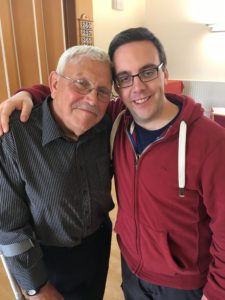
El Paso by Marty Robbins is the greatest song ever written. That’s not just my opinion; that’s the opinion of my Grandad, David Frederick Foxcroft, who died with dementia in 2020. It’s worth noting my Grandma is also suffering from dementia. I love her dearly, but this is about Grandad.
Over the last few months I have been chatting with Nick Shaw, from Dementia Disco, about what music can do for those who suffer from dementia, and it’s striking to look back and see how music has thoroughly shaped my life.
Music cuts through the very middle of you.
Japanese, as a language, has a lot of words I like, and one of my favourites is kandō: being emotionally moved or deeply touched by something. I most deeply feel kandō when I am sharing music with my son.
I suffer from misophonia, which means that some noises irrationally make me anxious, think forks on a ceramic plate, or nails on a chalkboard.
For me, it’s children’s music. Jangly, toybox, Baby Shark. I can’t stand it. But it brings me great joy to play music for my son. Arcade Fire to John Shuttleworth. Black Sabbath to Labi Siffre. I get emotional sharing these things, because music is powerful. It hits a part of my brain no other thing can scratch.
Out in the West Texas town of El Paso…
I promise I will get back to my thoughts on Dementia Disco soon, but first I must talk even more about the greatest song ever written.
El Paso by Marty Robbins is a deep, rich and utterly unique song that, in my family at least, has been a touchstone, a time-travelling device and a powerful legacy for over 80 years. I probably love it because most people misunderstand it. And I love it for different reasons than my grandad does, and my son does.
It’s a story of a bad guy who thinks he’s a good guy. The girl never loves him. He thinks differently. His mind is so clouded by love that he kills a man. And in the end he rides back for “his love”, only to get a simple peck on the cheek as he dies.
It’s such a good story that it’s, spoilers here, the plot of the final episode of Breaking Bad, aptly called Felina after the woman in the song, only it’s drugs, or power, replacing the ‘Mexican girl.’
And this is where dementia comes back in. One thing dementia does, very cruelly, is remove some of the context of the world. The unnamed cowboy doesn’t have all the facts, or at least doesn’t understand them. Maybe he needed to listen to some music.
When context fades, rhythm doesn’t.
Let’s move back to Dementia Disco, and specifically, the Dance Against Dementia.
Dance Against Dementia was a 66.7-day community campaign where thousands of people danced in solidarity to demand that dementia diagnosis and care remain a national political priority.
The Dance Against Dementia campaign wasn’t polite. It wasn’t a white paper. There were 5,668 acts of defiance set to music. Sixty-six point seven days of dancing in response to the quiet removal of a number, the 66.7% diagnosis target, from NHS guidance. A percentage deleted. A line item erased. As if dementia itself could be softened by omission.
So people danced.
They danced in parks and kitchens and cruise ships. They danced outside the Produce Hall and inside football grounds. They danced in Zumba classes, at Morris dancing gatherings, in gyms, in discos, in community halls. Over a thousand people moved together in the largest Morris performance in the world. Hundreds joined a flashmob beneath the Royal Nawaab Pyramid. Supporters, security guards and first aiders at Stockport County all found themselves pulled into rhythm.
There is something deeply subversive about dancing in public.
You cannot dance and remain detached. You cannot dance and remain entirely self-conscious. And you certainly cannot dance and ignore one another. Movement demands connection.
Dementia strips context, but it often leaves music intact. It leaves muscle memory. It leaves the chorus of a song learned at sixteen. It leaves the sway of a body that once knew a partner’s hand without looking.
Dementia Disco’s Dance Against Dementia understood this instinctively. It turned diagnosis statistics into something you could feel in your feet. It made absence visible. It made silence noisy.
On the final day, they danced twelve miles. From Mossley (where my family lives now) to Stockport Old Town, where my Grandad worked on the gas towers. Singing. Playing songs. Car horns answering back like a strange urban orchestra. People pulling over to donate on the spot. Volunteers walking every step.
By four o’clock, the number was handed over: 5,668 dances. Not signatures. Not clicks. Dances. Presented to a local representative, to be carried onwards to Parliament. A physical manifestation of memory and insistence.
My grandad loved El Paso because it told a story that refused to be small. Dementia Disco does something similar. It refuses to let dementia become background noise. It refuses to let it be quietly administratively reduced.
Music cuts through the middle of you.
And when memory fractures, it is often music that remains whole.
That’s what makes a lasting thing. Not permanence. Not policy. Not even statistics. A song shared across four generations. A flashmob under a pyramid. A thousand people stepping in time. A body remembering when the mind cannot.
Maybe the unnamed cowboy needed better context. Maybe we all do.
But when context fades, rhythm remains.