
I had a moment of absolute wonder, and it was at a service station.
Now I don’t want a cold, grey, bazaar of boring when I want a welcome break in my moto.- I want a positive experience. I want Brightside.
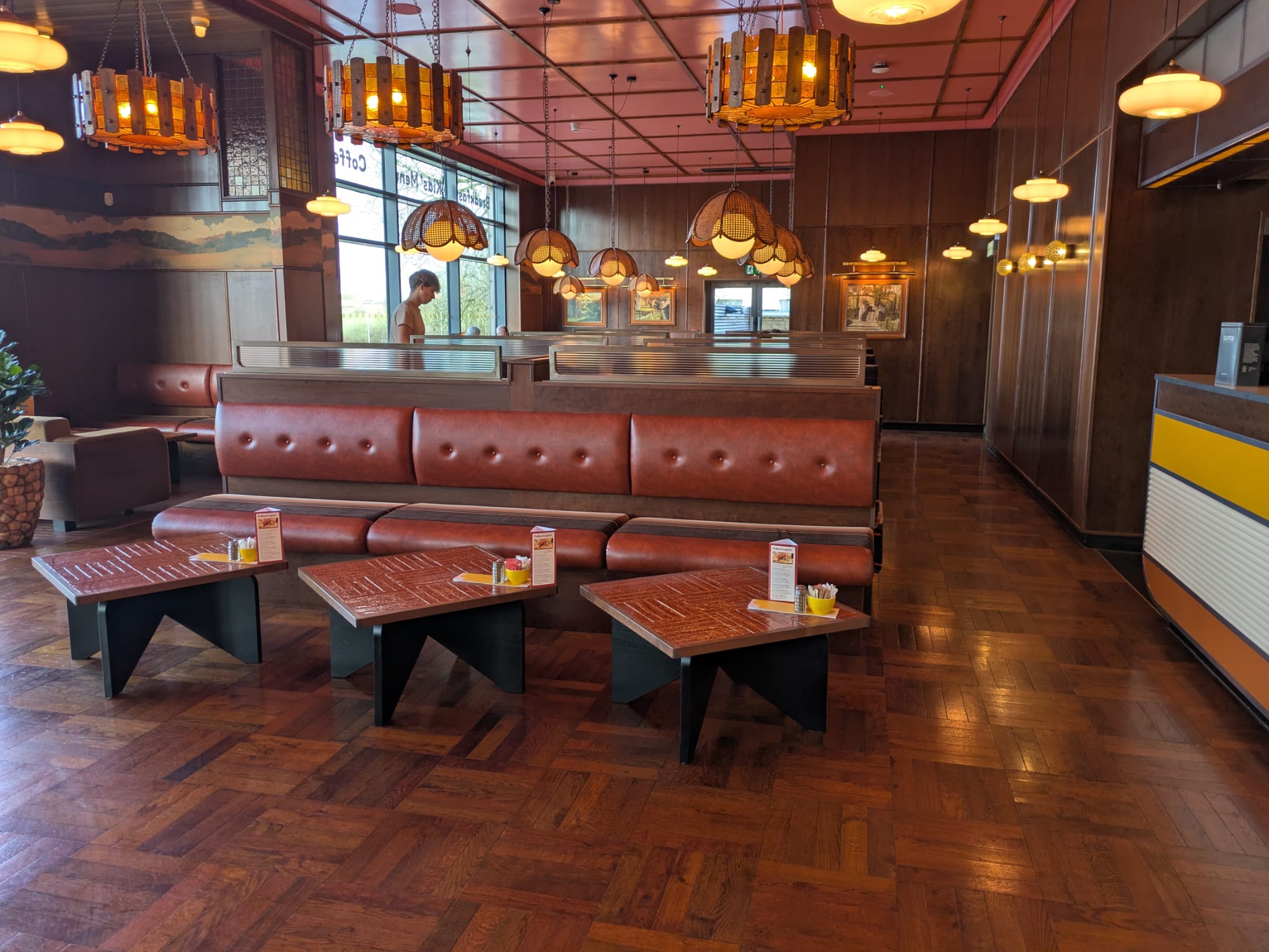
An experience I wasn’t expecting when all I needed was a drink.
There is a particular sadness to the modern service station. You know it before you even pull off the road. The same grey palette. The same queues. The same sense that you are not meant to linger, enjoy, or remember any of it. Fuel in. Food in. Back on the road. No story attached.
Which is why stumbling across Brightside at Ram Jam Services just of the A1, felt less like stopping for lunch and more like discovering a forgotten lay-by from another era.
This is not fast food pretending to be interesting. It is roadside dining that has decided the road itself still matters.
Brightside is intentionally different, and you feel that immediately.
The space does not rush you. The design does not apologise. Comfy places to sit just inside the door. A welcoming staff that asks how you are, and genuinely makes you think they care.
Aesthetics make the experience for better or worse.
There are lessons at Brightside for taking a different path. For them, it’s leaning fully into a 1970s aesthetic that is warm, confident and oddly reassuring. Wood panelling. Bold colours. Graphic typography. It feels closer to a road trip memory than a retail unit. And at 38, I don’t remember the seventies, but I sure feel at home, as did my son.
That matters. Nostalgia is not just decoration. It is the experience.
The 70s theme does more than look good. It connects you to a time when travel was part of the adventure rather than something to endure. When stopping was allowed. When places had character. Brightside understands that experiential travel does not have to involve passports or plane tickets.
Sometimes it is about reclaiming the in-between moments we have trained ourselves to rush through.
Customer Service from a bygone age
And then there is the service.
I was genuinely struck by how human it was. Not scripted friendliness. Not corporate cheerfulness. Just people who seemed present, calm and interested in doing things well. Food arrived quickly but not carelessly. Questions were answered properly. There was eye contact. It felt hosted rather than processed.
That sounds like a small thing. It is not.
Customer service is the difference between a pit stop and a place. Brightside gets that. They understand that experience is delivered person to person, not brand to consumer. You leave feeling looked after rather than moved along.
The food itself fits the brief. Proper, unfussy, satisfying. The sort of meal that makes sense on a journey. Enough care to feel deliberate, enough simplicity to feel honest. Nothing performative. Nothing hollow.
Driving away, I realised something had shifted. I was already planning to stop there again. Actively choosing it. That is rare. They’d gotten my attention, and they’ll get my money.
Brightside has made me want to avoid the soulless service stations altogether. The ones designed to extract money efficiently while offering nothing in return. Once you have experienced a place that treats the roadside as an opportunity rather than a problem, it is hard to go back.
This is experiential travel at its most understated. No spectacle. No gimmicks. Just intention, memory and care woven into a moment most businesses have written off as transactional.
Brightside reminds you that the journey still counts. That the spaces between destinations can hold meaning. And that sometimes the best travel experiences are the ones you did not plan for, just off the road, waiting for you to pull in.
The Lesson
What Brightside shows is that experience does not need to be expensive, flashy or technically complex. It needs to be coherent. The food, the design, the tone, the way you are spoken to and the way the space makes you feel all point in the same direction. That coherence creates trust. It tells customers that someone is paying attention. In a world full of places that feel designed by spreadsheet, that alone is enough to stand out.
The lesson for businesses is simple and uncomfortable. Stop treating experience as decoration. Stop assuming people will tolerate indifference because you are convenient. If you design for memory rather than throughput, for warmth rather than optimisation, people will choose you even when you are slightly slower or slightly out of the way. Brightside proves that when you give people a reason to feel something, they will happily avoid the soulless default.